Pecans are more than a Southern flavor in Georgia—they are one of the state's signature agricultural crops. A pecan tree can live and produce for generations, but successful home production depends on giving a very large tree enough room, choosing compatible cultivars, planning for pollination, and taking Georgia's humid climate and pecan scab pressure seriously.
Georgia's commercial pecan story took off later than many people might expect. Small-scale commercial production appeared in the late 1800s, followed by a major planting boom in southwest Georgia from roughly 1910 to 1925. Dougherty and Mitchell counties became important centers of the industry, and by the 1950s Georgia had become the nation's leading pecan-producing state.
Pecans remain part of Georgia's agricultural identity today. The Georgia Department of Agriculture identified Georgia as the nation's top producer of pecans in 2025, alongside peanuts and broilers. Southwest Georgia remains especially important to the crop, with the Albany area playing a major role in the industry's history.
Georgia Pecan Quick Facts
Commercial pecan production in Georgia began in the late 1800s.
A major pecan planting boom transformed parts of southwest Georgia between about 1910 and 1925.
Georgia became the nation's leading pecan-producing state by the 1950s.
Georgia was identified by the state Department of Agriculture as the nation's top pecan producer in 2025.
Pecan trees can become roughly 75 to 100 feet tall, making long-term site selection especially important.
How to Grow Pecan Trees in Georgia
Give the tree serious room: Pecans become very large shade trees. Consider mature canopy size, buildings, driveways, utility lines and neighboring property before planting.
Choose cultivars for Georgia conditions: Disease resistance, harvest date, cold tolerance and nut quality differ substantially among varieties.
Plan pollination before planting: A single isolated pecan tree may not crop well. Plant compatible cultivars with overlapping pollen shed and flower receptivity.
Prioritize full sun and drainage: Select a sunny location with deep, well-drained soil and adequate rooting space.
Water young trees consistently: Establishing trees need dependable moisture, while mature trees also benefit from adequate water during nut development.
Do not fertilize by habit: Base soil amendments and fertility decisions on soil and plant needs rather than automatically adding compost or balanced fertilizer every year.
Think about scab before buying: Georgia's warm, humid climate strongly favors pecan scab. For a home landscape, a resistant or lower-input cultivar can be much more practical than a highly susceptible commercial variety.
Georgia note: A cultivar that works well in South Georgia may not be ideal for North Georgia. Cold tolerance, spring freeze risk, disease pressure and harvest timing all matter.
Best Pecan Varieties for a Georgia Backyard
There is no single “best” pecan for every Georgia yard. UGA emphasizes cultivar selection because home gardeners generally cannot spray mature pecan trees the way a commercial orchard can. Scab resistance therefore deserves extra weight in a backyard planting.
Elliott: Known for excellent nut quality and a long record of strong scab resistance, but it can be vulnerable to late spring freezes and is not UGA's preferred choice for colder North Georgia sites.
Excel: Produces a large nut and has shown strong scab resistance, although resistance can change as disease populations adapt.
Gloria Grande and Sumner: Among cultivars UGA has listed for yard-tree plantings, with their own tradeoffs in bearing, pests, maturity and nut quality.
Kanza: Notable for cold hardiness and a useful option where late freezes make Elliott less suitable.
Pollination matters: UGA recommends at least two compatible varieties where nearby pecan pollen sources are limited. Pecan cultivars flower in different patterns, so choose a compatible Type I and Type II combination rather than simply buying two trees with different names.
What is a pecan?
A pecan is a type of tree nut that is native to North America. Pecans are known for their sweet, buttery flavor and are often used in cooking and baking. They are typically encased in a hard, dark brown shell and are harvested from trees. Pecans are a good source of nutrients, including fiber, protein, and various vitamins and minerals. They are also a source of healthy unsaturated fats, including monounsaturated and polyunsaturated fats. Pecans can be eaten on their own as a snack, or they can be used in a variety of dishes and recipes, such as pecan pie and pecan-crusted chicken.
From Georgia Pecans to the Kitchen
Pecans move naturally from the orchard into Southern kitchens. Beyond pecan pie, their rich flavor works in salads, savory coatings, baked goods and snacks. The recipes below give a Georgia pecan harvest another destination.
In a skillet over medium heat, toast pecan halves until fragrant.
Pour maple syrup over the toasted pecans and stir to coat.
Continue cooking for 1-2 minutes until the syrup thickens and coats the pecans.
Remove the candied pecans from the skillet and let them cool on parchment paper, separating them to prevent sticking.
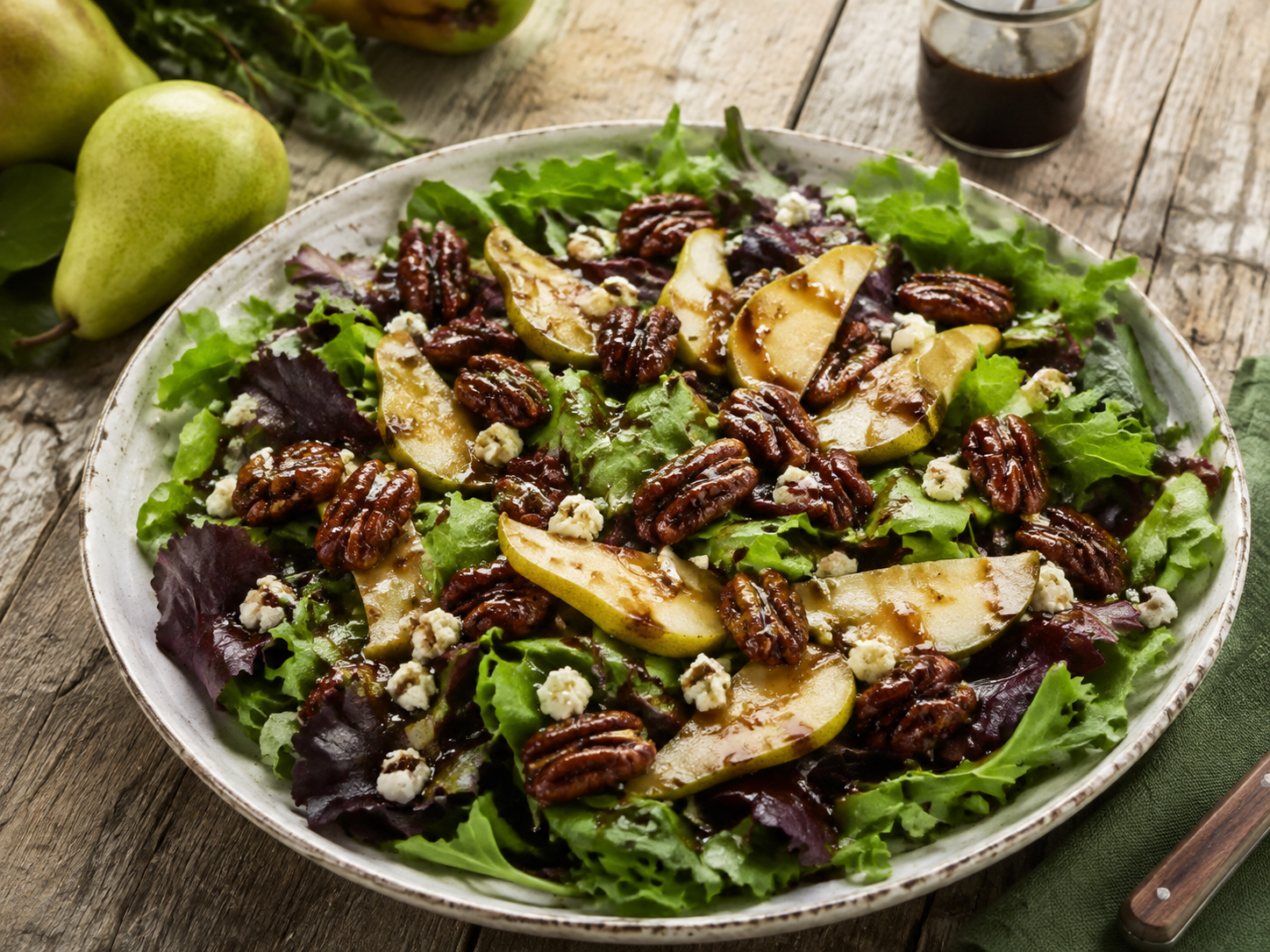
In a small bowl, whisk together balsamic vinegar, olive oil, salt, and pepper to create the vinaigrette.
In a large salad bowl, combine mixed greens, candied pecans, crumbled feta cheese, and apple slices.
Drizzle the maple balsamic vinaigrette over the salad and toss gently to coat.
Serve the Candied Pecan Salad as a delightful side or light meal.
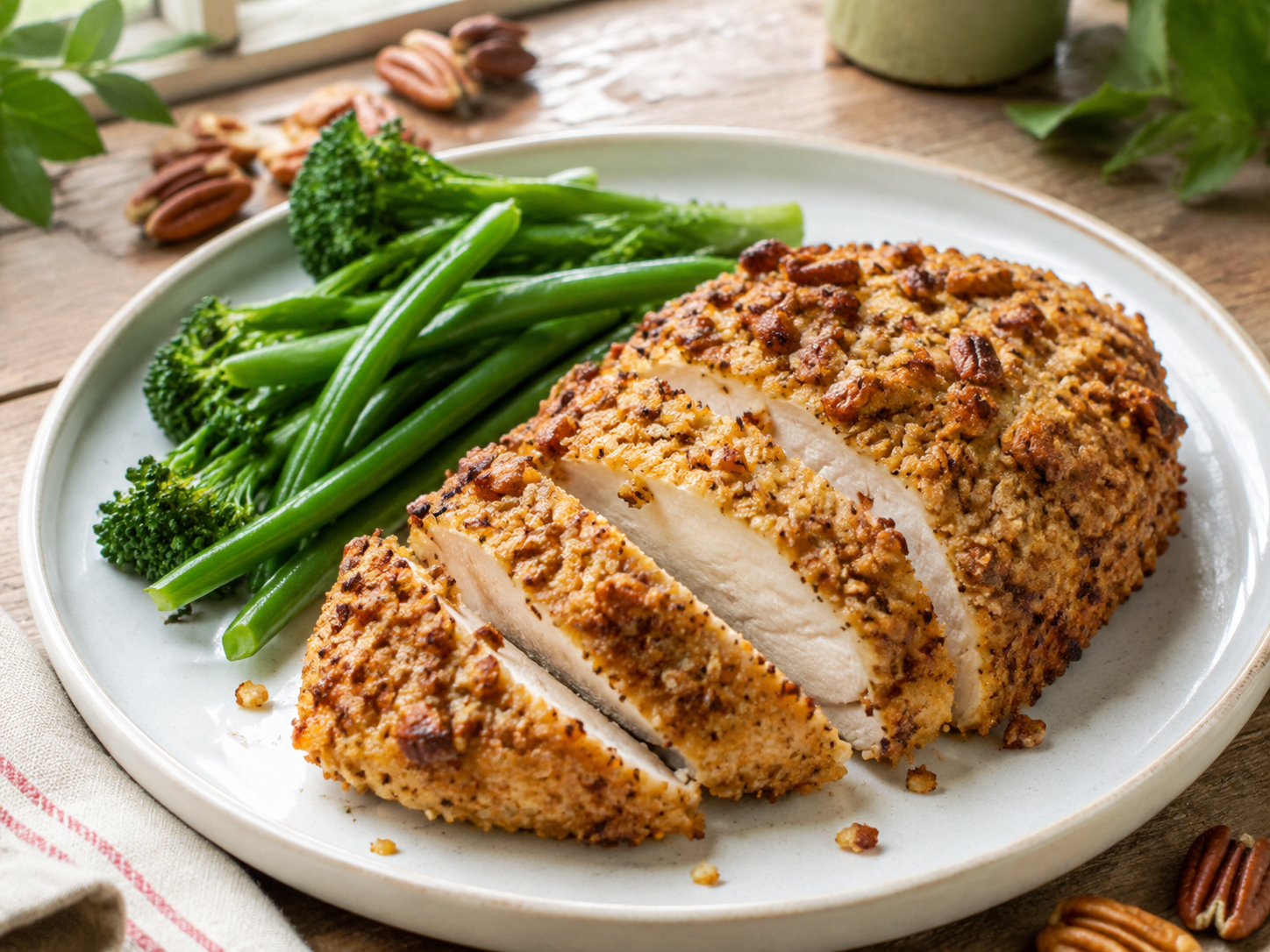
Pecan-Crusted Baked Chicken
Chicken breasts coated with seasoned pecans and breadcrumbs, then baked until crisp and tender.
Yield: 4 servings
Prep: 20 min
Bake: 25 min
Total Time: 45 min
Ingredients
4 boneless, skinless chicken breasts
1 cup finely chopped pecans
1/4 cup breadcrumbs
1 teaspoon dried thyme
1 teaspoon garlic powder
Salt and pepper to taste
1/4 cup Dijon mustard
2 tablespoons honey
2 tablespoons olive oil
Instructions
Preheat the oven to 375°F (190°C) and grease a baking sheet.
In a shallow dish, combine chopped pecans, breadcrumbs, dried thyme, garlic powder, salt, and pepper.
In another bowl, mix together Dijon mustard, honey, and olive oil.
Dip each chicken breast into the mustard mixture, coating both sides.
Press the chicken into the pecan mixture, ensuring an even coating on each side.
Place the coated chicken breasts on the prepared baking sheet.
Bake for 20-25 minutes or until the chicken is cooked through and the pecans are golden.
Serve the Pecan-Crusted Baked Chicken with your favorite side dishes.
These recipes highlight the rich and nutty flavor of pecans in both a vibrant salad and a savory pecan-crusted baked chicken.
Georgia Pecan Tree Seasonal Care
Pecans are long-lived trees, so their care is better viewed as an annual cycle than as a short vegetable-style growing season.
Late winter to early spring: Dormant-season planting is common for bare-root trees. Planting dates should reflect local weather and tree condition rather than one fixed statewide date.
Spring: Trees leaf out, flower and begin the pollination process. Young trees need consistent moisture as growth accelerates.
Late spring through summer: Nuts develop and size. Water stress during this period can reduce nut development. Warm, wet conditions also increase pecan scab pressure.
Fall: Depending on cultivar and location, shucks split as nuts mature and harvest begins. Pick up nuts promptly and remove poor-quality or damaged material.
Winter: Dormancy is a good time to evaluate tree structure, remove damaged wood when appropriate and plan soil or fertility testing for the coming season.
Common Pecan Pests and Diseases in Georgia
Georgia pecans can face both insect pests and diseases. For home trees, correct identification and cultivar choice are especially important because spraying a mature pecan canopy is often impractical.
Pecan Scab
Description: A fungal disease favored by Georgia's warm, humid and rainy conditions.
Damage: Dark lesions can develop on leaves and shucks, and severe infections can reduce nut quality and yield.
Management: For home plantings, choosing cultivars with useful scab resistance is one of the most practical defenses. Sanitation can help reduce carry-over of disease, and any fungicide use should follow current Georgia recommendations and the product label.
Pecan Weevil (Curculio caryae)
Description: Brownish beetles with distinctive snouts.
Damage: Pecan weevil larvae feed on developing pecan nuts, causing premature nut drop and reduced yields.
Control: Monitor nut development and pest activity and maintain good orchard sanitation. If treatment is warranted, use current Georgia recommendations and a product labeled for pecans and the identified pest.
Hickory Shuckworm (Cydia caryana)
Description: Small moths with brownish wings.
Damage: Larvae tunnel into developing pecan nuts, causing damage and reducing nut quality.
Control: Monitor nut development and pest activity and maintain good orchard sanitation. If treatment is warranted, use current Georgia recommendations and a product labeled for pecans and the identified pest.
Pecan Aphids (Monellia spp.)
Description: Small, soft-bodied insects that come in various colors.
Damage: Aphids feed on pecan foliage, causing leaf curling, distortion, and the production of honeydew, which can attract sooty mold.
Control: Conserve natural enemies and monitor aphid populations before treating. Large mature trees make unnecessary or poorly timed sprays especially undesirable.
Pecan Nut Casebearer (Acrobasis nuxvorella)
Description: Small moths with brownish wings.
Damage: Larvae feed on developing pecan nuts, causing damage and reducing yields.
Control: Monitor nut development and pest activity and maintain good orchard sanitation. If treatment is warranted, use current Georgia recommendations and a product labeled for pecans and the identified pest.
Black Pecan Aphids (Melanocallis caryaefoliae)
Description: Small, dark aphids.
Damage: Black pecan aphids feed on pecan foliage, causing leaf curling, distortion, and reduced photosynthesis.
Control: Conserve natural enemies and monitor black pecan aphid injury. Use labeled controls only when populations and damage justify treatment.
Stink Bugs (Various species)
Description: Shield-shaped insects with various colors.
Damage: Stink bugs feed on pecan nuts, causing damage to the kernel and reducing nut quality.
Control: Monitor nut injury and maintain orchard sanitation. Use labeled controls only when pest pressure warrants treatment.
Fall Webworm (Hyphantria cunea)
Description: White, fuzzy caterpillars with black spots.
Damage: Fall webworms create large webs on pecan trees, enclosing foliage and causing defoliation.
Control: On small trees, remove reachable webbing or heavily affected material when practical while conserving beneficial insects. Large established trees often tolerate some webworm feeding.
Pecan Scorch Mite (Eotetranychus hicoriae)
Description: Tiny, reddish-brown mites.
Damage: Pecan scorch mites feed on the undersides of pecan leaves, causing stippling, discoloration, and leaf drop.
Control: Confirm mite activity and monitor leaf injury before treating. Conserve natural enemies and use a labeled miticide only when warranted.
Integrated pest management (IPM) practices, including regular monitoring, early detection, and a combination of cultural, biological, and chemical controls, can help manage pest problems in pecan orchards effectively. Always follow recommended guidelines for the specific pest control methods you choose.
Georgia Companion Planting Around Pecan Trees
A mature pecan is a large shade tree with an extensive root system, so companion planting is different from a vegetable bed. Keep young trees free from strong grass and weed competition near the trunk. Farther from the tree, shade-tolerant groundcovers or seasonal flowers can add diversity without repeated deep cultivation around roots.
Remember the long view: today's sunny space beneath a young pecan may become deep shade as the canopy expands.
Pecans and Georgia Identity
Pecans are one of Georgia's signature agricultural products and deserve the same regional storytelling treatment as peaches, peanuts and Vidalia onions. For a home gardener, however, the important reality is scale: pecan trees become large, long-lived trees and need substantial permanent space.
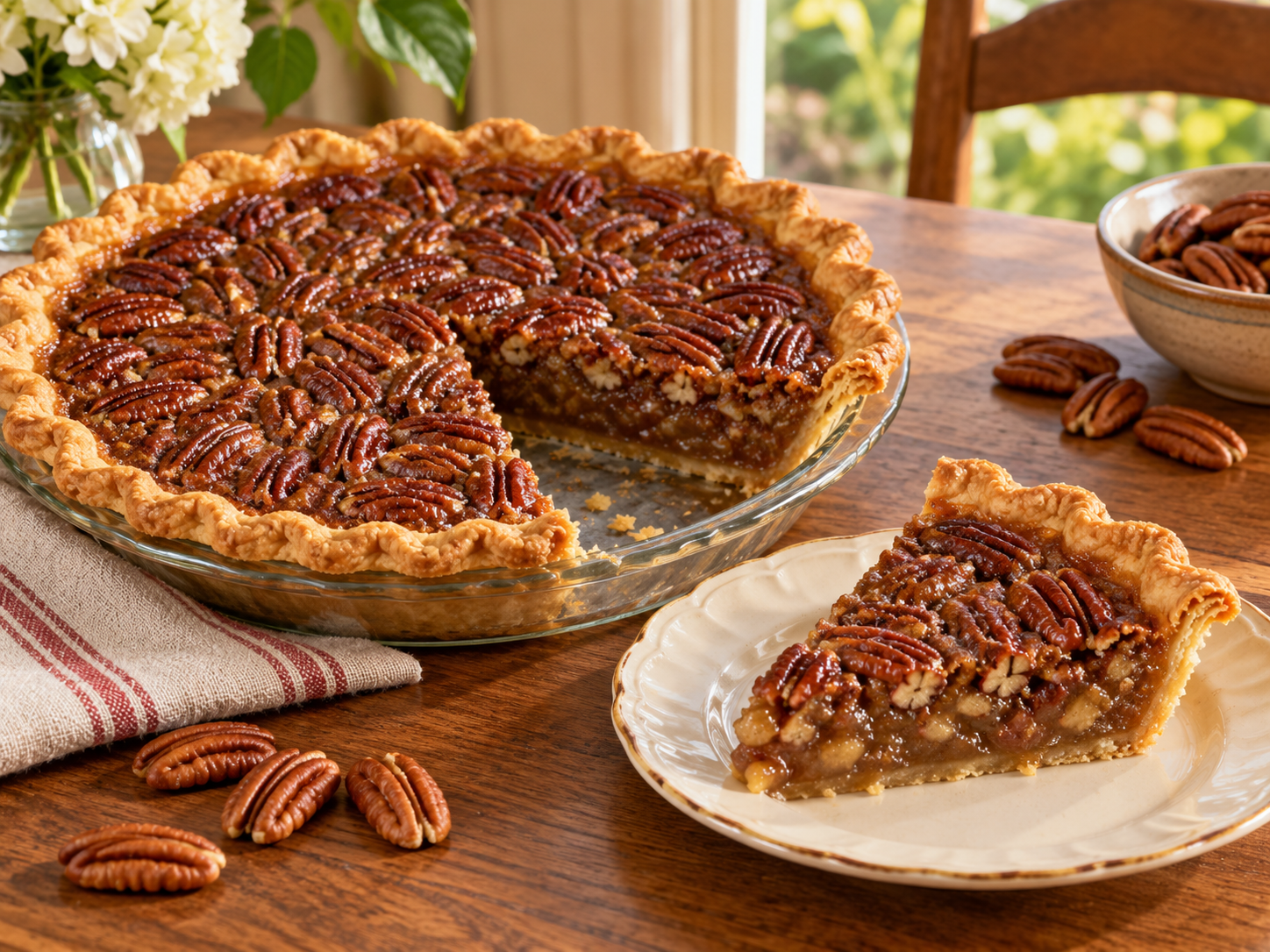
Classic Georgia Pecan Pie
Georgia pecans crown a traditional amber filling in a flaky crust for a rich, sliceable Southern dessert.
Yield: One 9-inch pie, 8 servings
Prep: 20 min
Bake: 55 min
Total Time: 4 hr 15 min
Ingredients
1 unbaked 9-inch pie crust, fitted into a pie plate
1 1/2 cups Georgia pecan halves
3 large eggs
1 cup light corn syrup
3/4 cup packed light brown sugar
4 tablespoons unsalted butter, melted and cooled slightly
1 teaspoon vanilla extract
1/2 teaspoon kosher salt
Instructions
Heat the oven to 350°F. Arrange the pecans evenly in the unbaked pie shell.
Whisk the eggs, corn syrup, brown sugar, melted butter, vanilla and salt until smooth. Pour slowly over the pecans.
Bake for 50 to 55 minutes, until the edges are set and the center gives a slight wobble when the pie is gently moved. Shield the crust edge with foil if it browns too quickly.
Cool on a rack for at least 3 hours before slicing so the filling can set completely.
Garden note: The pie is done before the center becomes completely firm; carryover heat finishes the set. Store covered in the refrigerator for up to 4 days.
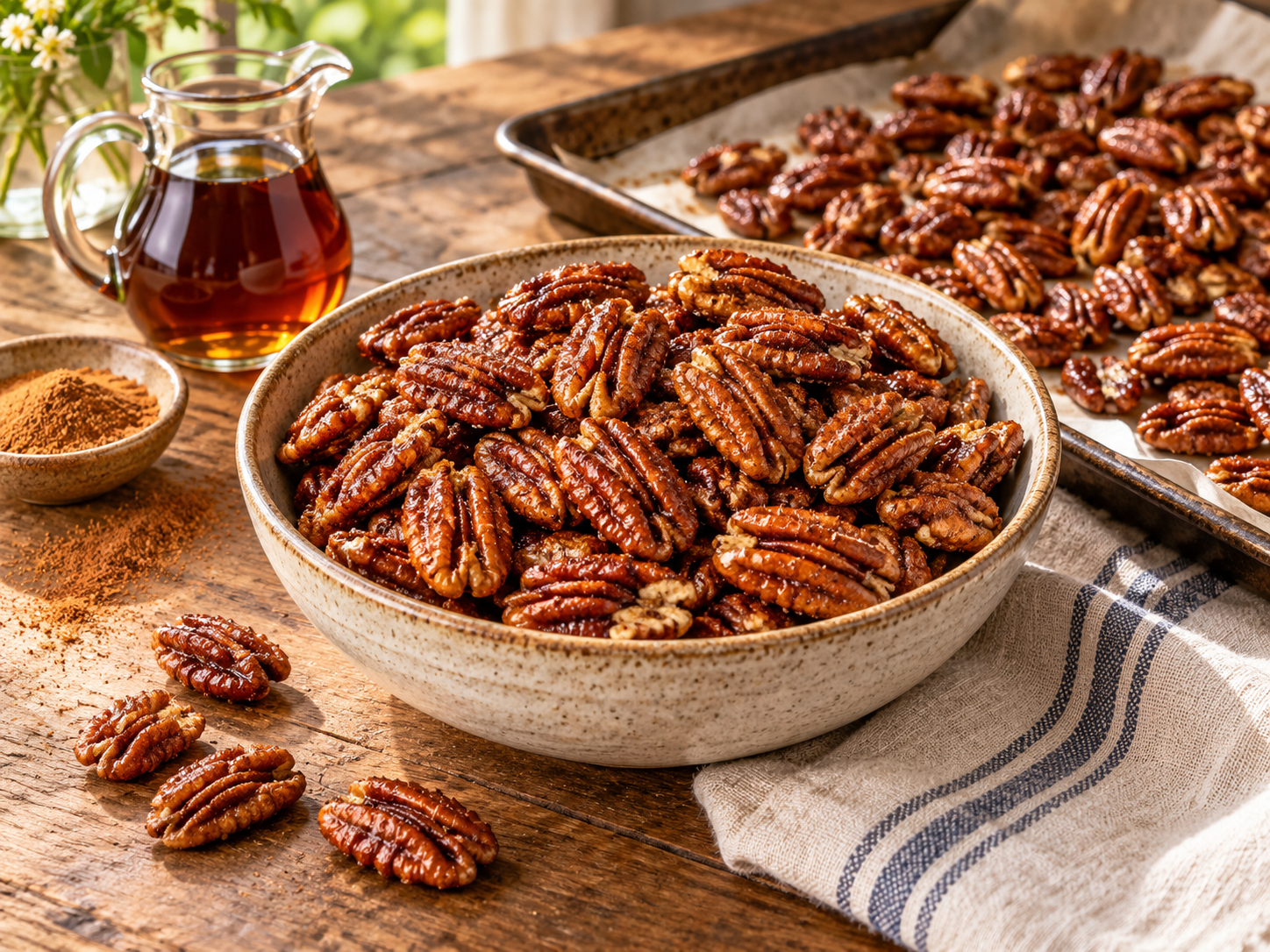
Maple Cinnamon Roasted Pecans
Georgia pecan halves roast in a light maple-cinnamon coating for a crisp, sweet-spiced snack with a touch of salt.
Yield: 4 cups, about 12 servings
Prep: 10 min
Bake: 27 min
Total Time: 37 min
Ingredients
4 cups raw pecan halves
1/3 cup pure maple syrup
1 tablespoon unsalted butter, melted
1 teaspoon ground cinnamon
1/2 teaspoon kosher salt
1/4 teaspoon vanilla extract
Instructions
Heat the oven to 300°F and line a rimmed baking sheet with parchment paper.
Whisk the maple syrup, melted butter, cinnamon, salt and vanilla in a large bowl. Add the pecans and toss until evenly coated.
Spread the pecans in one layer. Bake for 22 to 27 minutes, stirring twice, until fragrant and the coating looks nearly dry.
Separate any touching pecans with a spatula and cool completely on the pan before serving or storing.
Garden note: The coating crisps as the pecans cool. Store them airtight at room temperature for up to 1 week, or freeze for longer storage.
Pecan cultivar recommendations, pollination combinations and disease-management guidance can change over time. For research-based recommendations, consult University of Georgia Cooperative Extension and your county Extension office.